
A Practical Framework for Evaluating MGPS Tender Submissions
10/23/20262 min read

Start with a Consistent Evaluation Method
Comparing medical gas pipeline system (MGPS) tenders requires more than lining up quoted prices. A structured review helps determine whether each proposal meets clinical, technical and operational needs—and makes differences between bidders clear and traceable. Before opening commercial offers, define mandatory requirements, preferred features and the evidence bidders must provide. Use the same criteria and scoring rules for every submission.
Begin by checking scope compliance. Confirm that the tender covers all required gases, buildings, departments, plant rooms, distribution zones and interfaces. Identify deviations, assumptions and omissions, including work assigned to others. Record each item as compliant, partially compliant, non-compliant or requiring clarification. A missing component should not be treated as equivalent to a compliant offer simply because it is not separately priced.
Compare the Technical Design and Equipment
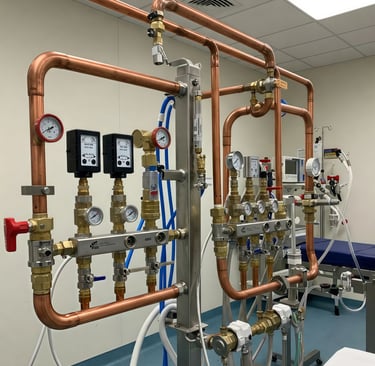
Assess the proposed source equipment against required capacity, duty and standby arrangements, performance and applicable standards. Compare manufacturers and models for compressors, vacuum plant, manifolds, alarms and other major equipment. Review pipeline materials, dimensions, joining methods, installation requirements and documented suitability for medical gas service. Check that terminal units and outlets match the required types, locations and quantities, and that proposed alarm systems provide the specified local and central monitoring.
Redundancy deserves particular attention. Establish whether the design maintains supply during equipment failure or planned maintenance, and whether the stated standby capacity is genuinely available under the required operating conditions. Do not assume that similar equipment descriptions mean equivalent performance. Request technical schedules, drawings, calculations and manufacturer documentation where needed to verify claims.
Evaluate Testing, Handover and Support
Compare each bidder’s plans for installation inspections, pressure and leakage testing, cross-connection checks, gas identity and quality verification, and commissioning. Confirm who performs each test, what standards and acceptance criteria apply, and whether test records and certificates are included in the handover package. A credible programme should also explain commissioning coordination, staff training, operating documentation and resolution of defects before acceptance.
Review warranty duration, start date, covered parts and labour, response times, exclusions and the process for making a claim. Assess ongoing service support, including preventive maintenance, emergency callout availability, spare-parts arrangements and the qualifications of service personnel. A long warranty may offer limited value if important equipment or labour is excluded, or if support cannot meet the facility’s needs.
Use a Framework That Makes Differences Visible
An illustrative comparison framework can use one row for each requirement and columns for: requirement or scope item; bidder response; evidence provided; compliance status; clarification or risk; and weighted score. Group rows under scope, source equipment, pipelines, outlets, alarms, redundancy, testing and commissioning, warranty, exclusions, and service support. Keep commercial information in separate columns or a distinct review stage, recording base price, options, lifecycle costs and exclusions consistently.
First determine whether each tender satisfies mandatory technical requirements. Treat unresolved safety-critical gaps as issues to clarify or grounds for rejection under the tender rules—not as minor disadvantages that a low price can offset. Then score compliant offers against published preferences and compare their full commercial implications. Document the rationale for scores and decisions. This approach supports a fair, auditable evaluation and helps select an MGPS solution that is fit for purpose, supportable and dependable—not merely the cheapest bid.
Services
© 2024. All rights reserved.
Products

We're Making it easier to find Better Medical Devices
Find us on Map:
Contact Information
Phone: +91 9029457428 | +91 9833236604 | +91 7506374381
Email : medevices2018@gmail.com | sales@medevices.in